Affichage des articles dont le libellé est marie antoinette. Afficher tous les articles

jeudi 29 mai 2014

Petit Trianon - MA's domain II

In the year 1668, king Louis XIV (1638-1715) bought the little village of Trianon, right near Versailles. He wished to build a palace where he and his family could rest, away from the strong "étiquette" and rules of the court. That's how was built the Grand Trianon in the years 1780, today known as the Grand Trianon.


Grand Trianon, EPV

Few years later, king Louis XV (1710-1774), great-grandson of Louis XIV, with the advices of his 'favorite' Madame de Pompadour (1721-1764) decided to build a second palace in Trianon. This one was supposed to be used for botanical studies by the scientists Richard and Jussieu.  The king entrusted the works to his dear architect Ange-Jacques Gabriel (1698-1782), who recreated the interiors of Versailles for him. For this second palace, the king chose a Greek-inspired architecture, marking a difference with the Rocaille style in fashion in the early years of the reign. 
The works began in 1762 in the gardens of Trianon. Unfortunately, Madame de Pompadour was not able to see the palace achieved, she died in 1764. After six years, the works were done and the brand new palace could be enjoyed by the King and his new favorite Madame Du Barry. Louis XV enjoyed the palace as his ancestor enjoyed the Grand Trianon. He came there mainly with his favorite. She was much less enclined to scientific studies than her predecessor, and the original botanical purposes were quickly abandonned. The palace was starting to be associated with adultary, pleasure, and profligacy.


The columns characterizing the Greek inspiration, Petit Trianon, EPV

The palace is a square of 20 m wide, including two floors. It marked a rupture with the Rocaille style that characterized the early years of Louis XV's reign.


Engraving of the palace extracted from
 Guide illustré des palais et des jardins de Trianon, 1887Gallica

The Northern front was made of a simple architecture, lookig towards the English Garden. The front facing the French Garden is the most Greek like, decorated with columns.
The palace was completely restored in 2008 thanks to a sponsorship with Montres Bréguet.


View of the Petit Trianon from the English Garden, Christian Milet, EPV

When Marie Antoinette arrived in France in the year 1770, she showed a profound interest for the small palace. In 1774, Louis XVI offers it to her "Vous aimez les fleurs, j'ai un bouquet pour vous, c'est le Petit Trianon" (You like flowers, I've got a bouquet for you, it is the Petit Trianon). He gave her a magnificient keyring decorated with 531 diamonds. It was the very first time that a Queen of France was becoming proprietary of her own domain, which caused a scandal because she was also a foreigner.


Louis XVI gives the key to the Petit Trianon to Marie Antoinette,
from  'Marie Antoinette' by S. Coppola, 2007

In her palace, Marie Antoinette replaced the figure of Louis XV with her own.

Thomas Garnier, EPV
She allowed her friends to visit her on invitation. They were chosen for their personnality, and not for their title of position at court as it was usual. Once they had been invited, they were written on a register held by the concierge Bonnefoy, and were given a token in order to enter the domain.
Among the most regular visitors were the Polignac couple, Axel de Fersen (alledged lover of the Queen), Madame Elisabeth (little sister of Louis XVI), the King, and her own children.


The salon de compagnie was a room dedicated to leisure (games, music, discussions,...).


Salon de Compagnie, Thomas Garnier, EPV

In one of the room on the ground floor, she had arranged mirrors to pull up in front of the windows, so that she wouldn't be spied on when on her retreat. This brought a huge scandal regarding the behaviors of the Queen and her alleged adultaries.


Cabinet des Glaces Mouvantes, Satoshi Nakagawa on WikiCommons

It was a place exempted from protocole (when the Queen enterred a room, no one had to stand up and bow to her as they were forced to do in Versailles). This brought back the sulfurous scent beared by the Petit Trianon with Madame Du Barry.
Critics began calling the palace "Small Vienna" or "Small Schönbrunn" and many pamphlets circulated speculating on what was happenning in the Petit Trianon (most talked about orgies, since most of the Queen's entourage were libertines, and there were no servants).

On October, 5th 1789, women of Paris marched on Versailles asking for bread for the people. the queen had to leave the Petit Trianon to stay alongside her huseband. It was the last time that she saw her dear palace.


A libertine vision of the Queen's journeys in the Petit Trianon,
extract from 'Marie Antoinette' by S. Coppola, 2007

During the Revolution, most of the furniture was sold in auction, as happenned for the one in Versailles. Popular balls and popuar feasts were organised in the domain of Trianon.
In 1805, with the coronation as Emperor of Napoleon Bonaparte (1769-1821), the Petit Trianon  took back its prestigious rank of palace. The Emperor to his beloved sister, Pauline Princess of Borghese. Restoration works were engaged after all the damages that had been done by the revolutionnaries. Festivals were held in the Trianon and the gardens surrounding by the Imperial family. later, the Petit Trianon was given to Napoleon's second wife Marie-Louise (1791-1847).


Marie-Louise's bedchamber in the Petit Trianon, Starus on WikiCommons
After the fall of Napoleon's Empire in 1815, monarchy was restored and king Louis XVIII was crowned. He offered the Petit Trianon to Marie-Thérèse de France, duchess of Angouleme and daughter of Louis XVI and Marie-Antoinette. Unfortunately, her memories of the place were far too painful for her and she only made a few visits there but chose not to stay there..

In the year 1830, Louis Philippe (1775-1850), duke of Orléans, was appointed "Roi des Français" (King of the French) by the assembly of deputies. He decided to restore the Palace of Versailles and to install a museum dedicated to all the glories of France ("Musée dédié à toutes les gloires de la France"), which was to be the first museum of French History (which I will surely write about in a while). To monitor the works, he and his family settled in the Petit Trianon.


The family of the Duke of Orléans in the gardens of the Peit Trianon,
 
engraving of a drawing by Charles-Jean Guérard
Under the Second Empire, Empress Eugénie (1826-1920), wife of Napoleon III, admired very much Marie Antoinette. She ordered that all the original furniture and decorations shall be put back at their original place. The problem was that these had been sold under the Revolution, and it was very hard to find everything back.Still today not everything is back in place, and the Palace of Versailles regularly buys  at auctions objects and settings that were once part of the domain (like this magnificient porcelain plate aquired a few days ago by the museum).


Bust of the Impress Eugénie, Salle Eugénie du Petit Trianon [X]

The palace was completely restored in 2008 thanks to a sponsorship with Montres Bréguet.
It possible today to visit the main rooms, and the Petit Trianon is very appreciated by all visitors. personnally I fell in love with the place, it is so cosy and much more intimate than the impressive Great Apartments back in Versailles ! It was funny to learn that most of the marble used to build it originated from a place very near my hometown in the Pyrénées mountains.

dimanche 9 février 2014

Marie Antoinette's Inside Cabinets


The tradition in Versailles had always been for sovereigns to have apartments for "apparat", apartments for the court life, for public appearances, for public ceremonies (Grand Lever, Grand Souper,...), but the kings and queens in Versailles also could enjoy more private apartments, where they could spend some private time, with their close relatives and friends. If you've seen the 2007 Sofia Coppola film 'Marie Antoinette' you might remember that the queen spends some of her time alone in rooms quite smaller than the official ones.

L'escalier des porteurs d'eau,
 first step into a quiet little world (photo by me)
I am going to try to describe you a part of the Queen's private apartments, or as we call them in French 'les Cabinets Intérieurs de la Reine', which I had the privilege to visit last summer.


We access them through a hidden door in the end of the Queen's Great Apartments, door obviously locked for most visitors. It was quite an amazing feeling to pass from the crowded apartments to this empty quiet staircase.


Once we climbed these stairs, and after two or three rooms with no particularity, we arrived at the entrance of the Cabinet Doré (Golden Cabinet), in which we could not enter for security reasons, but with the door entirely open, we were still able to see the beautiful room.
© EPV/ Christian Milet
It is the largest room of all Marie Antoinette's private apartments. it was there that the queen received most of her private guests, including her Ministre des Modes (Fashion Minister) as she liked to call her, Rose Bertin, or her official poraitis Elisabeth Vigée-Lebrun (whom we saw here). It was also in this room that she liked to take her music lessons. We can see a harp in the background, it actually belonged to the Queen and was crafted by the luthier and composer Jean-Henri Naderman in 1774 (he is reknown among harpists for writing several sonatas, inspired by the cour of Versailles).

We then moves on towards another room, much smaller than this one, the Cabinet de la Méridienne.
© EPV/ Jean-Marc Manaï
This little room was sort of a refuge for the Queen. She used to come here to rest on the sofa, whithout being disturbed. Indeed, she could lock herself in from the inside, thanks to the lockets on both doors. It was installed in the years 1780, when Marie Antoinette was pregnant with the second royal baby, whom everyone was hoping to be a boy, so that he kingdom would have its "dauphin". On the wooden walls are crafted some dolphins (symbol of the heir to the throne of France), eagles (symbols of the Austrian empire where the queen was born), and other feminin and royals symbols. On the fireplace is displayed a bust representing the son that Marie Antoinete finally had, who was destined to become Louis XVII, born in 1785 (he died during the Revolution).
Detail of the window  (photo by me)
Details of the door (photo by me)

After this quiet moment in this beautiful cabinet, we continued our visit to a series of small rooms, all quite ravishing, and impressively small, when we know the reputation marie Antoinette had for the "grandiose".

photo by me

photo by me

photo by me

photo by me
We then went down a flight of stairs and arrived right on the other side of the door that we can see in the Queen's Great Bedchamber.
On the other side, we can see usual tourists (photo by me)


samedi 14 septembre 2013

Le Temple de l'Amour et Le Belvédère - MA's domain I

As you may know, queen Marie Antoinette had a very important influence at Versailles. She was also very fond of nature, and wished for what she called a "simpler" life. She started wearing simpler white dresses, and was spending most of her time in the Trianon, where she established a more casual way of living, whithout any étiquette to dictate conducts.

In the end of the 1770's some elements were build for her in what was to be called 'Marie Antoinette's domain'. Royal architect Richard Mique started by conceiving the Temple de l'Amour, behind the Petit Trianon. It is an open-air temple, with in its center, a statue of Love (Ancient Greek god Eros) woodcrafting his bow, from Hercule's bludgeon. The temple was build upon asmall island on the river that runs through the gardens. It was suposed to be in harmony with the English Garden that surrounds it. The English Garden is a style known for the diversity of its plants, and is supposed to be an imitation of wild life (as opposed to the 17th century French Garden composed by geometrical gardens ).


Photo EPV Christian Milet

Marie Antoinette organized parties in her gardens. For exemple, in 1781, servants disposed candles and bonfires all through the fields. The fires were also set behind the Temple, to give a perfect lighting. These parties were reknown for their ephemeral luxury.
The queen's evenings were also set around the Belvédère and the Rocher.


'Illumination du pavillon du Belvédère (r) et du Rocher (l)' by Claude-Louis Chatelet (RMN)
The Belvédère was built at the same time as the Temple de l'Amour. It was also designed by architect Richard Mique who was very much appreciated by Marie Antoinette. He created an octogonal pavillion, with great windows on each side, to offer the queen a perfect panoramic view of her domain. The pond in front of it, offers a beautiful reflection in the day, and when the Belvédère is lit during celebrations.


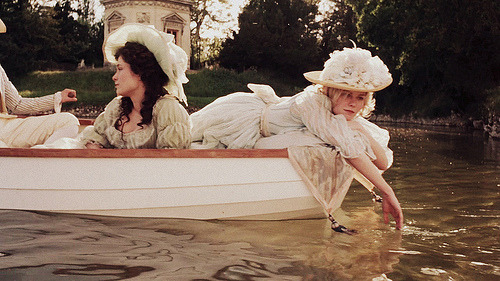
Marie Antoinette (Kirsten Dunst ) resting on a boat in the pond, with the Belvédère in the background
 (Sofia Coppola, 2007)


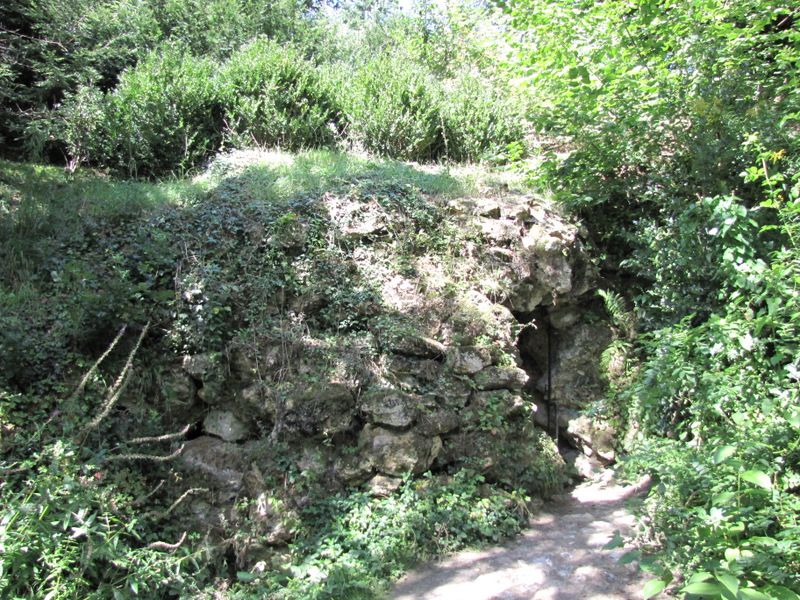
As I explained, Marie Antoinette had a passion for wild life. That is also why she asked for a cave to be created right next to the Belvédère, where she could have private meetings, or just read alone, in a quiet place. This cave protects the queen's privacy, because to enter, you have to cross a path that can be very muddy, surrounded by weeds and brambles. Totally artificial, it was sort of a private, nature room for Marie Antoinette. It was also set so that the queen could see who was coming towards the cave whithout being seen herself. This need for privacy of MA created a scandal at court. There were numerous rumours about this place, most of them were that the queen built it to welcome secret lovers, who were, according to the rumours, very numerous.


The path to the entrance of the cave (photo from acbx41.com)


This cave is also famous because on October 5th of 1789, Marie Antoinette was resting here when a servant brought a letter from the minister Saint-Priest, informing her of the arrival of the Parisian women at Versailles, who were there to complain about the enormous price rises the country faced, and to capture the Royal Family.


Marie Antoinette appearing at the balcony, in front of the Parisians, Anonymous

For me, it was the first time I saw these wonderful things this summer. To be honest, I felt really emotionnal in front of the cave, because I knew that this very small thing was important in my country's history. Unfortunately I didn't saw any ghost of the former queen, like these two british women did during the 1901 summer.


If you want to learn more about this, here are two French speaking links.

  • Extract from the show Secrets d'Histoire about the domain 
  • Radioshow about the 5th of October 1789


lundi 2 septembre 2013

Marie Antoinette's portraits

As many people around the world, I am fascinated with the life of Marie-Antoinette, the most famous queen of France (but not the last one as many people think, but I'll explain another time).


She was the daughter of the Empress of Austria. In 1770, at the age of 14, she was married to the French Dauphin (heir to the throne), Louis Auguste. Their marriage was made to bring peace between France and Austria, which had been enemies for a long time.
Marie Antoinette by Duplessis (unfinished). Photo RMN
Since the marriage was planned, at the end of the 1760's, Marie Antoinette had been portrayed many times, so that some of the paintings could be sent to the French court, where the King and Louis Auguste could see her face. The Dauphine was paying attention to her appearance. In all her portraits, she saw herself as unpretty. The Palace of Versailles even keep some sketches for portraits of Marie-Antoinette which are not completely finished, because she thought it was too ugly.


All changed when she met Elisabeth Vigée-Le Brun. Women painters were rare at court, but Marie Antointette invited her, because she was very pleased with her work.The most famous portrait of the queen was by Mrs. Vigée-Le Brun, in 1783. It is called 'Marie Antoinette à la rose' (Marie Antoinette with a rose). It is a painting that everyone knows today, and one of the most asked in Versailles. People want to see this portrait, because it is the best ever made of the queen. It also has an interesting history.

Sclossmuseum, Darmstadt, Germany (photo RMN)

When Vigée first painted it, she presented it at the Salon. The Salon, was an exhibition of the best French painters of the year. The first painting she presented was a portrait of the queen, dressed in a very simple white dress. This was considered as an offence to monarchy, because a queen could not be shown dressed that simple ! Even though this painting received such a scandal, the 'chemise de la Reine' (Queen's shirt), became quickly the new fashionable dress among noble women.
To keep the painting displayed in the Salon, Vigée-Lebrun had to paint it over. The result is one of the most famous portrait of all art history, which is now exhibited in the first floor antichamber Trianon, in Versailles.

Photo RMN