Affichage des articles dont le libellé est XVIIIe siècle. Afficher tous les articles

samedi 29 mars 2014

Madame de Pompadour's Private Apartment

  Jeanne Antoinette Poisson, Marquise de Pompadour (1721-1764), was a woman of bourgeois origins, she did not descended from a family of the French nobility. In 1745, she had the good fortune to meet the king at a masked-ball organised in Versailles, where she managed to seduce the monarch with her beauty and her intelligence. He formalized her as his favorite, six months after their first meeting.
 Seven years later, the king and the marquise were no longer in love, but they kept a strong friendship. Jeanne-Antoinette even provided the king with young women, so that he would not choose a woman among these at Court. The king also sometimes asked for advises to her on state matters. He even kept her close to him, at the Palace. He bought for her the Hôtel d'Evreux, today known as the Presidential Palace de l'Elysée. While being the king's favorite, she used her influence to protect artists and writers (Voltaire, she permitted the publication of the two first volumes of L'Encyclopédie by Diderot and D'Alembert). 


Portrait en pied de la Marquise de Pompadour,
 by Maurice Quentin de La Tour, Musée de Louvre (RMN)

  In 1745, the king installed his lover in the apartment right above his own. This apartment hosted the monarch's previous favorite (Madame de Chateauroux). This small apartment offers an impressive view of the northern part of the gardens.

The stairs to access the apartment (photo by me)


View on the Northern Aisle, from the apartments of the Pompadour (photo by me)

  When I visited, luckily for me, the weather was incredible, the sun enterred joyfully in the rooms.
The apartment has been completely refurnished and redecorated few years ago, thanks to a generous sponsorship from a jewelry brand. These rooms are accessible with a special guiding tour focused on hidden apartments of the castle.

Cabinet of the marquise (photo by me)


Bedchamber (photo by me)

photo by me

photo by me

Madame Husset's (marquise's maid) room, a very small room usually closed to the public (photo by me)

Further informations:

* Article about the apartment on the site of the Palace
* Gallery from the Facebook account of the Palace
* Le Bal Des Ifs, by Franck Ferrand, an interesting biography of Madame de Pompadour by famous French writer and Versailles specialist Franck Ferrand. I found it easy to read and to understand all the mechanisms of the mid. 18th century French court.
Article about the marquise on Encyclopaedia Universalis by Louis Trenard (in French)
* Article about the marquise on Encyclopaedia Britannica by Nancy Mitford (in English)
* Extract from the show Secrets d'Histoire about the marquise (in French)

samedi 14 septembre 2013

Le Temple de l'Amour et Le Belvédère - MA's domain I

As you may know, queen Marie Antoinette had a very important influence at Versailles. She was also very fond of nature, and wished for what she called a "simpler" life. She started wearing simpler white dresses, and was spending most of her time in the Trianon, where she established a more casual way of living, whithout any étiquette to dictate conducts.

In the end of the 1770's some elements were build for her in what was to be called 'Marie Antoinette's domain'. Royal architect Richard Mique started by conceiving the Temple de l'Amour, behind the Petit Trianon. It is an open-air temple, with in its center, a statue of Love (Ancient Greek god Eros) woodcrafting his bow, from Hercule's bludgeon. The temple was build upon asmall island on the river that runs through the gardens. It was suposed to be in harmony with the English Garden that surrounds it. The English Garden is a style known for the diversity of its plants, and is supposed to be an imitation of wild life (as opposed to the 17th century French Garden composed by geometrical gardens ).


Photo EPV Christian Milet

Marie Antoinette organized parties in her gardens. For exemple, in 1781, servants disposed candles and bonfires all through the fields. The fires were also set behind the Temple, to give a perfect lighting. These parties were reknown for their ephemeral luxury.
The queen's evenings were also set around the Belvédère and the Rocher.


'Illumination du pavillon du Belvédère (r) et du Rocher (l)' by Claude-Louis Chatelet (RMN)
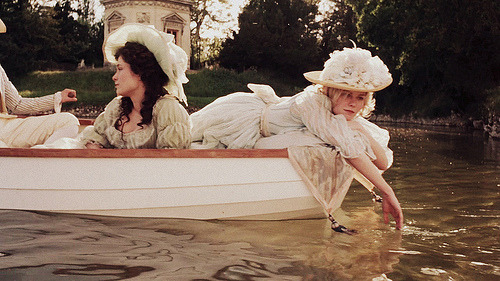
The Belvédère was built at the same time as the Temple de l'Amour. It was also designed by architect Richard Mique who was very much appreciated by Marie Antoinette. He created an octogonal pavillion, with great windows on each side, to offer the queen a perfect panoramic view of her domain. The pond in front of it, offers a beautiful reflection in the day, and when the Belvédère is lit during celebrations.


Marie Antoinette (Kirsten Dunst ) resting on a boat in the pond, with the Belvédère in the background
 (Sofia Coppola, 2007)


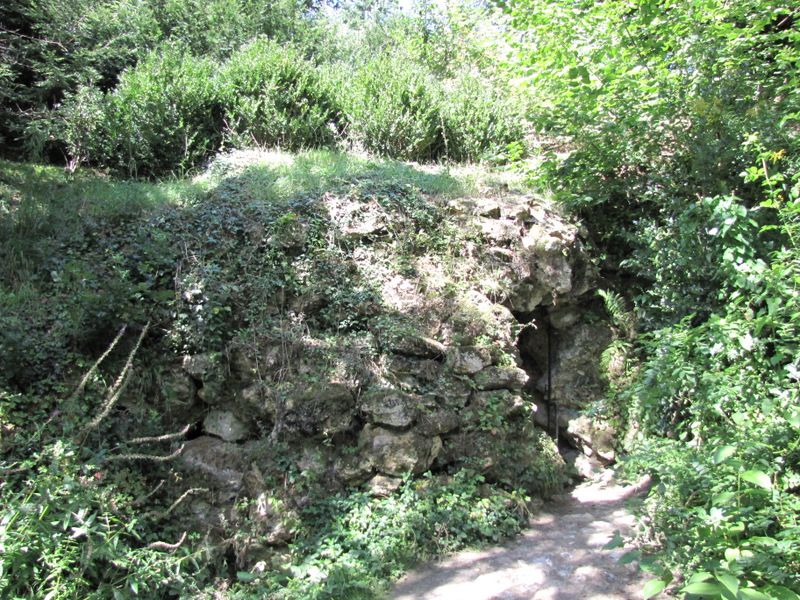
As I explained, Marie Antoinette had a passion for wild life. That is also why she asked for a cave to be created right next to the Belvédère, where she could have private meetings, or just read alone, in a quiet place. This cave protects the queen's privacy, because to enter, you have to cross a path that can be very muddy, surrounded by weeds and brambles. Totally artificial, it was sort of a private, nature room for Marie Antoinette. It was also set so that the queen could see who was coming towards the cave whithout being seen herself. This need for privacy of MA created a scandal at court. There were numerous rumours about this place, most of them were that the queen built it to welcome secret lovers, who were, according to the rumours, very numerous.


The path to the entrance of the cave (photo from acbx41.com)


This cave is also famous because on October 5th of 1789, Marie Antoinette was resting here when a servant brought a letter from the minister Saint-Priest, informing her of the arrival of the Parisian women at Versailles, who were there to complain about the enormous price rises the country faced, and to capture the Royal Family.


Marie Antoinette appearing at the balcony, in front of the Parisians, Anonymous

For me, it was the first time I saw these wonderful things this summer. To be honest, I felt really emotionnal in front of the cave, because I knew that this very small thing was important in my country's history. Unfortunately I didn't saw any ghost of the former queen, like these two british women did during the 1901 summer.


If you want to learn more about this, here are two French speaking links.

  • Extract from the show Secrets d'Histoire about the domain 
  • Radioshow about the 5th of October 1789