Affichage des articles dont le libellé est chateau de versailles. Afficher tous les articles

dimanche 9 février 2014

Marie Antoinette's Inside Cabinets


The tradition in Versailles had always been for sovereigns to have apartments for "apparat", apartments for the court life, for public appearances, for public ceremonies (Grand Lever, Grand Souper,...), but the kings and queens in Versailles also could enjoy more private apartments, where they could spend some private time, with their close relatives and friends. If you've seen the 2007 Sofia Coppola film 'Marie Antoinette' you might remember that the queen spends some of her time alone in rooms quite smaller than the official ones.

L'escalier des porteurs d'eau,
 first step into a quiet little world (photo by me)
I am going to try to describe you a part of the Queen's private apartments, or as we call them in French 'les Cabinets Intérieurs de la Reine', which I had the privilege to visit last summer.


We access them through a hidden door in the end of the Queen's Great Apartments, door obviously locked for most visitors. It was quite an amazing feeling to pass from the crowded apartments to this empty quiet staircase.


Once we climbed these stairs, and after two or three rooms with no particularity, we arrived at the entrance of the Cabinet Doré (Golden Cabinet), in which we could not enter for security reasons, but with the door entirely open, we were still able to see the beautiful room.
© EPV/ Christian Milet
It is the largest room of all Marie Antoinette's private apartments. it was there that the queen received most of her private guests, including her Ministre des Modes (Fashion Minister) as she liked to call her, Rose Bertin, or her official poraitis Elisabeth Vigée-Lebrun (whom we saw here). It was also in this room that she liked to take her music lessons. We can see a harp in the background, it actually belonged to the Queen and was crafted by the luthier and composer Jean-Henri Naderman in 1774 (he is reknown among harpists for writing several sonatas, inspired by the cour of Versailles).

We then moves on towards another room, much smaller than this one, the Cabinet de la Méridienne.
© EPV/ Jean-Marc Manaï
This little room was sort of a refuge for the Queen. She used to come here to rest on the sofa, whithout being disturbed. Indeed, she could lock herself in from the inside, thanks to the lockets on both doors. It was installed in the years 1780, when Marie Antoinette was pregnant with the second royal baby, whom everyone was hoping to be a boy, so that he kingdom would have its "dauphin". On the wooden walls are crafted some dolphins (symbol of the heir to the throne of France), eagles (symbols of the Austrian empire where the queen was born), and other feminin and royals symbols. On the fireplace is displayed a bust representing the son that Marie Antoinete finally had, who was destined to become Louis XVII, born in 1785 (he died during the Revolution).
Detail of the window  (photo by me)
Details of the door (photo by me)

After this quiet moment in this beautiful cabinet, we continued our visit to a series of small rooms, all quite ravishing, and impressively small, when we know the reputation marie Antoinette had for the "grandiose".

photo by me

photo by me

photo by me

photo by me
We then went down a flight of stairs and arrived right on the other side of the door that we can see in the Queen's Great Bedchamber.
On the other side, we can see usual tourists (photo by me)


dimanche 8 décembre 2013

Versailles at Night


Recently, several photos were posted on the Versailles Facebook page. They were picturing the magnificent castle at night, with a very special lightning.
The clock, photo : EPV / Thomas Garnier
The Entrance, photo by : EPV / Thomas Garnier

The facade of the palace under the light. photo: EPV / Thomas Garnier
Hall of mirrors : EPV / Thomas Garnier


dimanche 29 septembre 2013

Versailles on Wiki Commons

If you're not following the Chateau de Versailles on Facebook or on Twitter, you definitely should ! I met the people in charge of these accounts, and they explained to me what they were doing with these. They try to make discover hidden places, organizing little contests, talking about press articles about the Palace. It is really interesting and very fun.
 A few days ago, they published a little article about the recent partnership they had with Wiki Commons, offering a great range of beautiful aerial pictures of the domain.

All of them are really amazing ! I post some of them here, and leave you the link to see them all.
https://commons.wikimedia.org/wiki/Category:Aerial_views_of_the_domain_of_Versailles


samedi 14 septembre 2013

Le Temple de l'Amour et Le Belvédère - MA's domain I

As you may know, queen Marie Antoinette had a very important influence at Versailles. She was also very fond of nature, and wished for what she called a "simpler" life. She started wearing simpler white dresses, and was spending most of her time in the Trianon, where she established a more casual way of living, whithout any étiquette to dictate conducts.

In the end of the 1770's some elements were build for her in what was to be called 'Marie Antoinette's domain'. Royal architect Richard Mique started by conceiving the Temple de l'Amour, behind the Petit Trianon. It is an open-air temple, with in its center, a statue of Love (Ancient Greek god Eros) woodcrafting his bow, from Hercule's bludgeon. The temple was build upon asmall island on the river that runs through the gardens. It was suposed to be in harmony with the English Garden that surrounds it. The English Garden is a style known for the diversity of its plants, and is supposed to be an imitation of wild life (as opposed to the 17th century French Garden composed by geometrical gardens ).


Photo EPV Christian Milet

Marie Antoinette organized parties in her gardens. For exemple, in 1781, servants disposed candles and bonfires all through the fields. The fires were also set behind the Temple, to give a perfect lighting. These parties were reknown for their ephemeral luxury.
The queen's evenings were also set around the Belvédère and the Rocher.


'Illumination du pavillon du Belvédère (r) et du Rocher (l)' by Claude-Louis Chatelet (RMN)
The Belvédère was built at the same time as the Temple de l'Amour. It was also designed by architect Richard Mique who was very much appreciated by Marie Antoinette. He created an octogonal pavillion, with great windows on each side, to offer the queen a perfect panoramic view of her domain. The pond in front of it, offers a beautiful reflection in the day, and when the Belvédère is lit during celebrations.


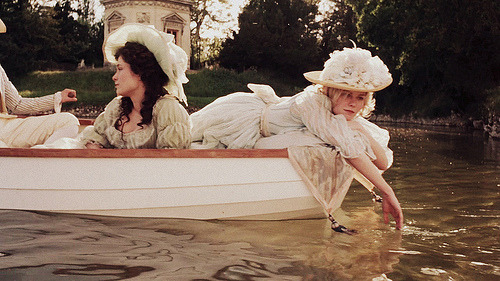
Marie Antoinette (Kirsten Dunst ) resting on a boat in the pond, with the Belvédère in the background
 (Sofia Coppola, 2007)


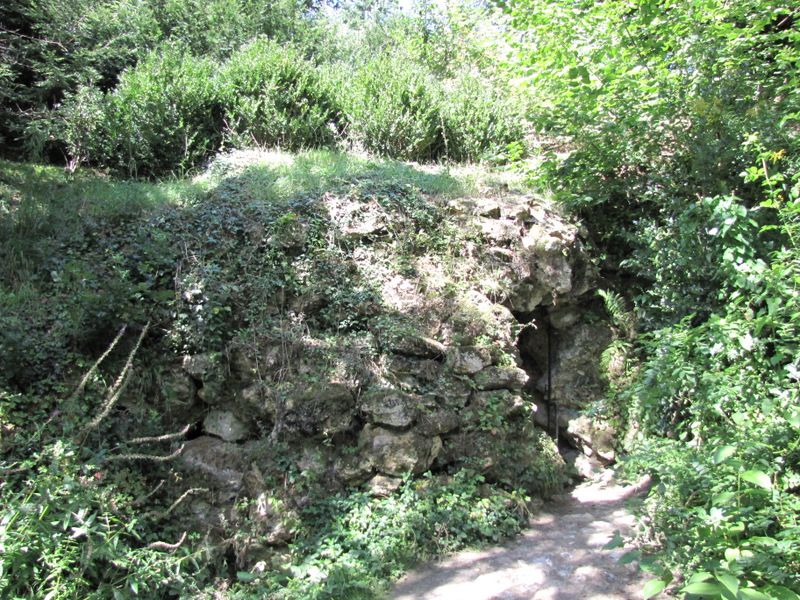
As I explained, Marie Antoinette had a passion for wild life. That is also why she asked for a cave to be created right next to the Belvédère, where she could have private meetings, or just read alone, in a quiet place. This cave protects the queen's privacy, because to enter, you have to cross a path that can be very muddy, surrounded by weeds and brambles. Totally artificial, it was sort of a private, nature room for Marie Antoinette. It was also set so that the queen could see who was coming towards the cave whithout being seen herself. This need for privacy of MA created a scandal at court. There were numerous rumours about this place, most of them were that the queen built it to welcome secret lovers, who were, according to the rumours, very numerous.


The path to the entrance of the cave (photo from acbx41.com)


This cave is also famous because on October 5th of 1789, Marie Antoinette was resting here when a servant brought a letter from the minister Saint-Priest, informing her of the arrival of the Parisian women at Versailles, who were there to complain about the enormous price rises the country faced, and to capture the Royal Family.


Marie Antoinette appearing at the balcony, in front of the Parisians, Anonymous

For me, it was the first time I saw these wonderful things this summer. To be honest, I felt really emotionnal in front of the cave, because I knew that this very small thing was important in my country's history. Unfortunately I didn't saw any ghost of the former queen, like these two british women did during the 1901 summer.


If you want to learn more about this, here are two French speaking links.

  • Extract from the show Secrets d'Histoire about the domain 
  • Radioshow about the 5th of October 1789


dimanche 8 septembre 2013

Closing Days

One of the best privileges I got when working at the Palace, was to be allowed in on mondays, the closing day.

If you follow the Palace on social medias (Twitter and Facebook), on monday, you can see pictures of the empty rooms and corridors. 


Empty Queen's Bedchamber (photo by me)

Empty Hall Of Mirrors (photo by me)

You may think that, since its closed, there is nothing inside, but you're wrong. There are less people than any other day, but still. There are people cleaning statues, floors, chandeliers. On monday, the Palace also offers visits for VIPs (for example, Leonardo Di Caprio came in June, or Kim & Kanye in May 2014). While wandering through the empty corridors, you can encounter curators watching paintings and art to see if there's any problems with it. Finally, monday is usually a shootingday for television documentaries or movies. For example, on my last monday at Versailles, I met three BBC journalists making a film about Louis XIV.


Salon de l'Oeil-De-Boeuf (photo by me)


One monday, we also realised a photoshoot of some furniture. The pictures we take are for the Réunion des Musées Nationaux (National Museums Reunion) and will be used for posters, postcards, and posted on the RMN's website .


photo by me

Salon de la Paix (photo by me)

lundi 2 septembre 2013

Marie Antoinette's portraits

As many people around the world, I am fascinated with the life of Marie-Antoinette, the most famous queen of France (but not the last one as many people think, but I'll explain another time).


She was the daughter of the Empress of Austria. In 1770, at the age of 14, she was married to the French Dauphin (heir to the throne), Louis Auguste. Their marriage was made to bring peace between France and Austria, which had been enemies for a long time.
Marie Antoinette by Duplessis (unfinished). Photo RMN
Since the marriage was planned, at the end of the 1760's, Marie Antoinette had been portrayed many times, so that some of the paintings could be sent to the French court, where the King and Louis Auguste could see her face. The Dauphine was paying attention to her appearance. In all her portraits, she saw herself as unpretty. The Palace of Versailles even keep some sketches for portraits of Marie-Antoinette which are not completely finished, because she thought it was too ugly.


All changed when she met Elisabeth Vigée-Le Brun. Women painters were rare at court, but Marie Antointette invited her, because she was very pleased with her work.The most famous portrait of the queen was by Mrs. Vigée-Le Brun, in 1783. It is called 'Marie Antoinette à la rose' (Marie Antoinette with a rose). It is a painting that everyone knows today, and one of the most asked in Versailles. People want to see this portrait, because it is the best ever made of the queen. It also has an interesting history.

Sclossmuseum, Darmstadt, Germany (photo RMN)

When Vigée first painted it, she presented it at the Salon. The Salon, was an exhibition of the best French painters of the year. The first painting she presented was a portrait of the queen, dressed in a very simple white dress. This was considered as an offence to monarchy, because a queen could not be shown dressed that simple ! Even though this painting received such a scandal, the 'chemise de la Reine' (Queen's shirt), became quickly the new fashionable dress among noble women.
To keep the painting displayed in the Salon, Vigée-Lebrun had to paint it over. The result is one of the most famous portrait of all art history, which is now exhibited in the first floor antichamber Trianon, in Versailles.

Photo RMN

samedi 17 août 2013

The Latona Fountain

Once you're in the gardens, and once you've passed the great stairs, you'll see the Latona fountain. It is one of the most interesting of them all.


Latona fountain, as seen from the stairs (photo RMN)

If you're familiar with Greek and Roman mythology, you might know the story behind this sculputre. On top, we can see a woman, Latona, with two children at her feet. These two are Apollo and Diane the twin gods Latona had with Jupiter. Juno, Jupiter's wife, forced her to exile in Minor Asia. When she arrived, Latona was rejected by the local peasants, who hated her, obeying Juno's orders. Latona implored Jupiter to help her and their children, the all-mighty god transform all of the peasants into frogs and toads. We can see the peasants under Latona here, some of them are completely transformed, but some are still half human-half toad.

This magnificient sculpture was made by the Marsy brothers, who worked almost all their life to work in Versailles for Louis XIV.


Currently, the fountain is in restoration, and to compensate, the Palace made several videos, explaining why this restoration was necessary to the fountain. You can watch more on their YouTube channel.


They also put a website online, to follow the restoration works: http://latone.chateauversailles.fr/

jeudi 15 août 2013

Hall of Mirrors

The most famous hall in the World, where there is the most people during the visiting day:
 the Hall Of Mirrors.
The Hall of Mirrors on a Monday, closing day at Versailles (photo by me)
When Louis XIV, the sun-king, build the Palace, on the same place where stood decades before his father’s hunting mansion, there was no Hall of Mirrors. Instead, a very large terrace that offerred the perfect view, with the perfect perspective on the gardens was built. But in Versailles, winters can be dificult and very long, so in 1678, the king decided to built a large hall that will connect his appartments to the queen’s ones
To keep a great view on the garden’s perspective, he invited the best mirror makers from Venice to create mirrors that would match the windows, giving the impression that the room was enlarged by them.

The king asked his first painter, Charles Le Brun, to decore the ceilings, with paintings dedicated to his own military victories against the others European nations.


'La puissance victorieuse du roi' by Charles Le Brun (photo RMN)


This hall was sometimes used as a ballroom, for parties and receptions, but was mostly used as a passage between the king's and the queen's appartements, linking the two most important part of the Palace.